When the leaves have all fallen and the trees are bare, there are treasures revealed that ignite the curiosity and wonder of children. At this time of year, our beautiful land offers us the gift of discovery, and the opportunity to delve deeply into learning about who lives in our community.
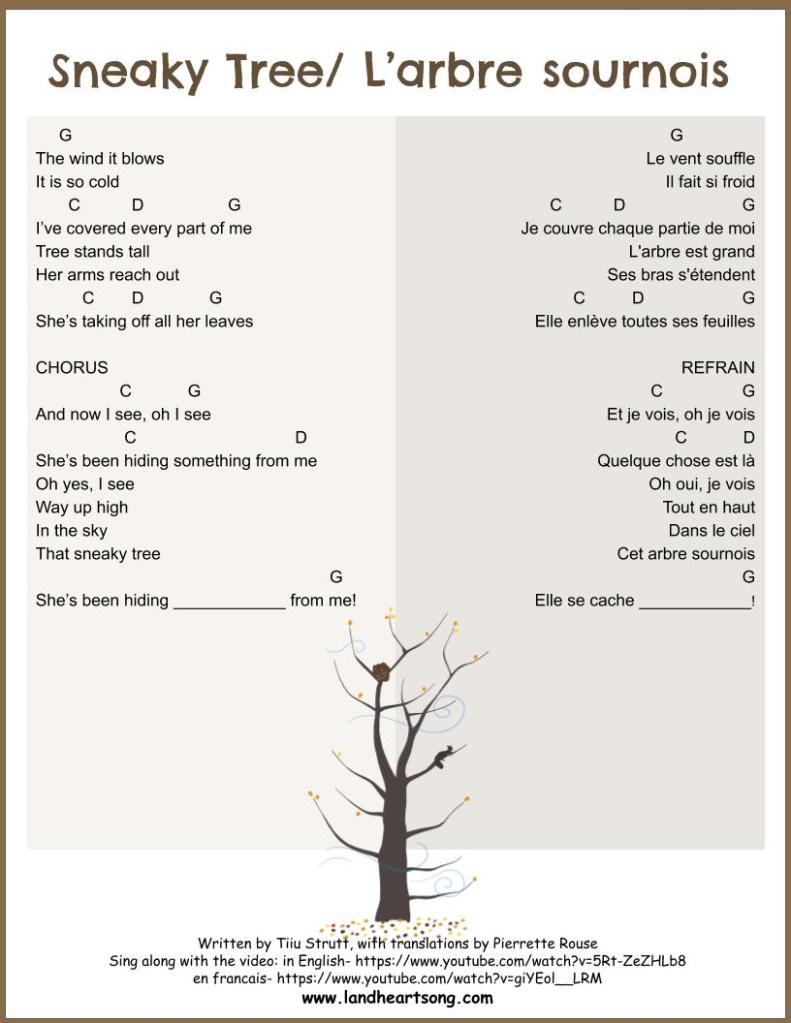
To inspire children to look up and consider the wonder that awaits them, I have written the song “Sneaky Tree” (in French, “L’arbre sournois”). This song is FUN, and I encourage you to jump right in and join the fun with your little ones! “Sneaky Tree” begs them to use their knowledge and imagination to consider who and what they may find in the branches of the bare trees. Pre-Covid, I would sing this song with students throughout November, asking them to “fill in the blank” about what they see in the branches of trees outside. As we continue to not be allowed to sing at school in my region, I have created these videos (one English, one French) to play in class, before heading outside to investigate our local trees. Depending on your situation, the videos may be helpful, or you may be able to sing the song live with your children or students. And then get outside and explore!
I spend time with students in “la classe verte” (a courtyard within the school) where we have five beautiful mature trees, four of whom are Sugar Maples. We are very lucky that a squirrel has chosen this special place as her home. When the leaves fall and students catch a glimpse of her nest, I love the hollers of excitement as children share their discovery with others. “A nest!!! I see a NEST!!! LOOK!!!”
I also love the conversations that ensue, as students make predictions as to who might be living there. Oftentimes, students think of birds; eagles and blue jays are frequently top of mind. This moment opens a door for us to develop a deeper relationship with the lives and needs of the living beings we share our special place with.
Last year, this experience launched an inquiry for us- who is living in “la class verte”? I suggested to students that maybe we should keep an eye out for clues in the coming weeks, such as taking note of any animals we do see in our “classe verte”. I also suggest we could do some research with books and the internet to see what different animal homes look like. Through this process, we were able to take some animals off our list. At one point, students noticed a squirrel, which led us to looking up squirrel nests (also called dreys). It was quite satisfying to have our question answered!
Investigating animal homes can also be a great launching pad for working with loose parts, as students enjoy exploring different natural materials to make a nest for an animal. It is fascinating to consider how animals use their bodies and the materials around them to make these incredible structures that will support them, throughout our harshest season of cold and wind. It is quite the challenge to try and build even a remotely comparable structure! I also find it fascinating to think about how animals transfer their knowledge through the generations!
Throughout the late fall and early winter, we revisit “Sneaky Tree”. In revisiting the song, it brings about the opportunity for children to share about what they are noticing outside, be it at school, or outside of school. It also encourages them to look up, make observations and ask questions. There is so much to explore and learn when the trees show us what they have been hiding!
BUILDING KNOWLEDGE AND COMMUNITY – #sneakytree
I hope you have fun with “Sneaky Tree”. If you make observations with your child(ren) or students, take a picture of what you observe, and post it with #sneakytree on Twitter or Instagram. I will collect pictures and share them out to our growing community. It will be fun to see what children are observing- I wonder if we will find similarities in our different communities!
CURRICULUM LINKS:
For those working in the school system, and looking for curriculum links, here are some ideas for FDK and Grade 1. If you have more links, please share them in the comments below! Let’s keep learning together!
FDK: This experience is rooted in an inquiry stance, and you can document student observations, predictions, and questions. You can also document the experience with pictures and have them write about the pictures, helping them communicate their understanding of the experience in a variety of ways.
Grade 1: This experience uncovers Science curriculum, including both The Needs and Characteristics of Living Things, as well as Structures. Again, you can document the experience with pictures, and/or give students an Inquiry Journal to connect to Literacy, and have them write about their learning.
Happy singing and exploring!
Tiiu
 Land Heart Song
One thought on “Sneaky Tree / L’arbre sournois”