I share with you today the song “Sweet Tree” (“Bel arbre” in French). This song captures the excitement of this time of year, when the days get longer, the sun gets stronger, and the Maple trees are magical. This song is intended to spark curiosity, and encourage children to look closely at the Maple trees for clues and signs of the changing seasons.
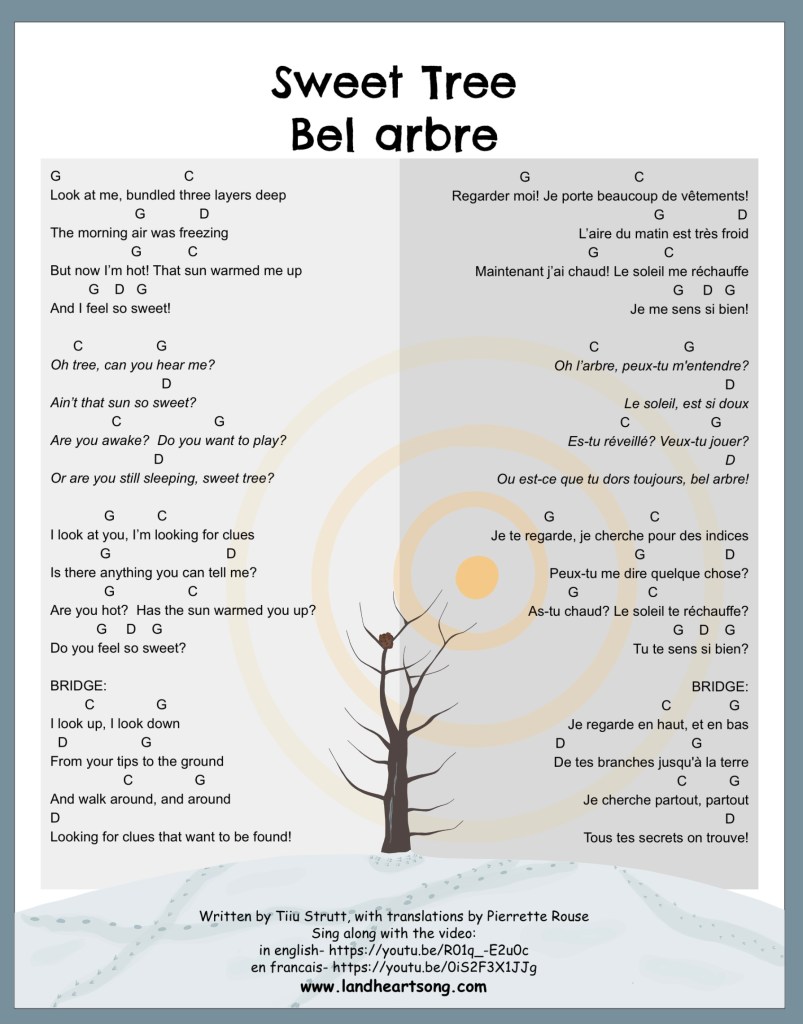
Click HERE for a PDF of lyrics and chords in English and French.
The magic of this time of year is undeniable. I still hold onto a vivid memory from my later youth, one of coming across an icicle hanging from a fallen Maple. It was March Break, and I was wandering through a forest with a good friend. The warm sun on our face and the delicious sweetness of the maple ice in my mouth is firmly imprinted in my memory!
In recent years, I’ve held witness to many children having magical Maple moments. Sometimes children notice a trace of ice down the trunk of a Maple, and start questioning why the ice is there. One year, our Maple trees had been recently pruned, and we noticed something like raindrops falling on a bright, sunny day. It took a moment to figure out it wasn’t actually rain falling, but something else. It was a great mystery! In all cases, once students realize we have stumbled upon the key ingredient to make Maple syrup, the excitement is contagious and quite joyful. So far, this connection has always come from a child or two who step forward, sharing their knowledge that Maple trees give Maple sap.
Last year, this moment sparked a great inquiry. After the discovery, one student mentioned that her family taps the Maple trees in her backyard, so we invited her mother to our class. Another community member with knowledge of Maple tapping joined us. Many classes became involved, and it was really exciting. All of the adults involved were non-Indigenous, and so I worked to find resources to support us in learning about how the tapping of Maples is Indigenous Knowledge that has been shared with settlers. During this inquiry, we learned about the history of the land and her First Peoples, and about Indigenous Knowledge shared with settlers. We learned so much about Maple trees. We also uncovered a lot of Math and Science, as we collected sap and kept track of how much we gathered! Through data management, students came to the conclusion that more sap flowed on sunnier, warmer days. Cool discovery!
The song “Sweet Tree” came from all of these moments. “Sweet Tree” is for singing on the sweet March days where the sun starts beating down, and everyone feels quite happily overdressed. Here in Southern Ontario, the jackets have started piling on the ground, the south facing trunks of our Maples are getting moist, and the first drops have already been spotted!
In creating the video for “Sweet Tree”, I connected with Paul Brooks at Brooks Farms. Brooks Farms is a wonderful family-run farm in my community that specializes in fun and educational experiences to connect children and families to the land and to agricultural practices. It is from their Sugar Bush that some of the video for “Sweet Tree” was captured. Paul and I talked about the history of Maple Syrup in this land, and he shared with me: “To tell the whole story, you need to bring in Indigenous Perspectives”. At Brooks Farms, they share their understanding of the history of this exchange of knowledge and of Indigenous Ways of Knowing with visitors to their Sugar Bush.
I, too, am striving to embed Indigenous Ways of Knowing in my work with children. This year, as children have already started witnessing the sap starting to move, I have been sharing what I know of the history of the land and how tapping Maples is Indigenous Knowledge that has been shared with settlers. It is a moment of acknowledgement and gratitude.
I am on a learning journey to understand better the history of this land and her First Peoples. I am grateful for many resources to support learning about Indigenous Ways of Knowing and about the history of the land, and the history, culture and traditions of her First Peoples.
This year, we find ourselves in a world where so much learning has become virtually available. As such, I am thrilled that webinars are surfacing to support our learning about Indigenous Ways of Knowing around Maple Syrup. I look forward to the following webinars, and to continuing to build my knowledge and understanding.
March 11 Earth Path- Sugar Bush: Methods, History and Ecology with Caleb Musgraves
I also recommend these reads:
Leanne Betasamosake Simpson’s article “Land as Pedagogy: Nishnaabeg intelligence and rebellious transformation”
“Colonialism, Maple Syrup, and Ways of Knowing” by Krista McCraken
In terms of learning more about Indigenous Education and Ways of Knowing, I recommend following the following individuals from my region, as they have helped me learn so much. I am grateful to them for their leadership, courage, strength and willingness to share:
Pamala Agawa
Natasha Bascevan
Towana Brooks
Jodi Johnston
Hopi Martin
Here is some recommended reading:
Tanya Talaga Seven Fallen Feathers
Robin Wall Kimmerer Braiding Sweetgrass
And finally…
Whose Land is an excellent resource to help you understand whose land you are living in.
I live in the land of the Williams Treaties. You can learn about the Treaties here, and I also strongly encourage you to read the Crown’s Statement of Apology for the Impacts of the 1923 Williams Treaties here.
Thank you for taking the time to listen to my story and my words.
 Land Heart Song
Love that you are connecting young minds with the land. I hope you are okay if I share this song with my students. Becky
LikeLike
Absolutely, Becky! These songs are for sharing so have fun! I’d love to hear how it goes 🙂
LikeLike